Showing posts with label coping strategies. Show all posts

19 March 2022

WTF

Spring, definitely, colourful, noisy and thanks to the winds from Africa, sandy. 

I am not well, what else is new. Yesterday, I gave a short presentation of a woman in her 60s who is fed up with chronic illness flare ups and the tedious pretense of remaining cool and calm. It was quite a performance, if I may say so, which was met with a solid round of applause from the one person who has seen it all over the years. Bless him.

I cancelled all appointments and tasks for the coming week which was supposedly a holiday week, with plans to climb mountains/cross the seas and have a haircut, obviously, and now I am blissfully resigned to listening falling asleep to podcasts and getting lost on the internets., while R has taken on my assignment for today, namely power cleaning the patio and greenhouse. He usually hates power cleaning and gave a little speech just now to tell me that he is doing this in exchange of me getting better. We shall see. 

So, here is what keeps me entertained.

More sheep and sheep dogs.
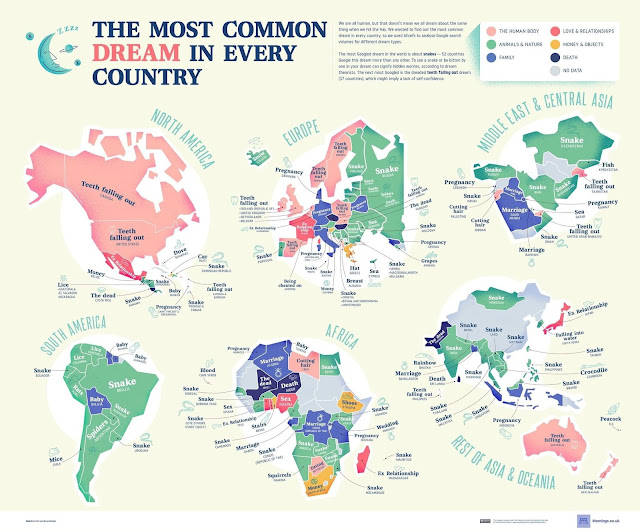
Stuff about dreams. Although I would have guessed, flying is on top of any list.
Human evolution, briefly:


Groundbreaking scientific findings: 


Benefits of swearing

Swearing in the physical therapy setting should be used to accomplish specific goals, such as relief from pain or stress. When swearing is based on biopsychosocial utility, it may add significant value if used correctly. Swearing tends to be more tolerated in private settings and among peers as opposed to a more formal and public setting. Swearing can lead to tighter human bonds and create informal environments where people are more likely to be themselves [3]. Social groups depend on some degree of shared willingness to participate in risks or taboo practices, swearing being one of them. In the physical therapy setting, an improved relationship or positive connection between a patient and a physical therapist, otherwise known as the therapeutic alliance, has been linked to improvements in musculoskeletal pain.

 It is advised to use a swear word that you would use in response to banging your head accidentally [15]. If no clear swear words come to mind, the S-word and F-word are the two most common swear words [8, 9] and were used by many of the subjects in the research showing the positive effects of swearing. There is evidence that a patient needs to use an actual swear word, not a made up or bad sounding word, to elicit the pain and physical performance improvements.

I can only recommend that you read the complete article, it's an excellent read, click here.

11 January 2019


In the early, very early morning hours I look out the kitchen window into the grey and wet garden. Desolate is a word I could use to describe the view but of course it's really just January - and jet lag.

A bit more than one day ago, I stood in the shade of frangipani and breadfruit trees by a small beach, watching plastic bottles drifting on the currents of the deep blue South China sea, gently landing and resting on the golden sand for a short moment before being whisked off by a uniformed young man. I tried polite conversation about the number of bottles he picks up in a morning and whether they come from ships or Indonesia or Malaysia. But he just smiled, his teeth very white, and bowed reassuringly. All clean now madam, and off he ran after the next bottle. My shirt was sticking to my back by the time the taxi driver offered me a cool cool bottle madam, and later on the plane, the supply was once again seemingly endless. Flying for three days includes a lot of plastic bottles.

Through my kitchen window I watch rain turn to sleet. I can faintly remember the birdcalls that now form the soundtrack to my grandchild's days. My garden in winter is silent.

Earlier, I calculated my life expectancy online. The Swiss offer me a stunning 30 years, the US is less enthusiastic with a mere 21 and Germany cuts it to 17 more years but only with a 50% probability and I had to click my way through three disclaimers before I got the result. 
(Obviously, I left out the bit about my shitty disease.) 

A week ago, I stood in front of the sign above, stunned and suddenly too much aware of what is ahead of us.

"The French philosopher Henri Bergson (. . .) developed a so-called process ontology, which claims that nothing in the universe is ever fixed. In fact everything that exists is an ongoing and evolutionary process (élan vital) without a fixed goal. And since—according to Bergson—our rational mind is solely capable of understanding and therefore predicting rigid entities but not processes, any belief in the complete predictability of the universe must be abandoned. Instead, we should focus on the possibilities of an open, spontaneous and creative future, which we will only then be able to understand, if we get more in touch with our so-called intuitive faculty, which is able to fathom a process in its processual state."

More here.


picture credit: educatingthedragon.blogspot.com


01 January 2018

new year's resolutions

According to reliable sources, Seamus Heaney’s  final words just before his death in 2013, texted to his wife, were noli timere –  do not fear.

If I should have to try and spell out a new year's resolution, Looking forward to next year, I could do worse than to bear these words in mind.

Because the more we fear, the more they win. Right? But then another new year's resolution of mine is to always ask, who are they?

My dream resolutions, the ones I haven't yet properly examined but which the spirits and fairies and pixies of winter have been whispering into my ear: retireretireretire and see someone about that paralyzed right foot (as in get to walk properly again).

And while we're at it, the big one, the resolution of resolutions, is to only buy stuff we need, absolutely need. This is actually not  very difficult now with R starting on his meagre pension next month. And seriously, we have everything we need. Stuff wise.

Other than that, I will let shit happen. I am 60 now, no need to get too excited.


New Year's eve was exceptionally mild, a weird spring day. We sat outside with our mugs of tea. We cycled without gloves. Today, it is cold again and that poor Meyer lemon is probably going to react badly to us moving it in and out and in and out. Right now, it's flowering and downstairs smells like Spain.
This was a week ago:


26 September 2010

jumble of emotions

It's been a hard two days. full of anxiety, tears and despair.
Last night in a song I heard this line "Be yourself" and there was a blank. I don't feel like myself any longer, I don't know this frightened woman I have become.
If anybody would have told me not too long ago that one day I will be faced with this enormous challenge to my health and spirit, I would have felt positive that I could handle it. Let it come, I would have said, look at me, I can do this - theoretically. And how I looked down on people who let themselves go - the way I do now.
Only, I am not sure if I let myself go. Rather, I seem to be struggling most of the time to stop myself falling to pieces. It's a fierce battle.

This afternoon, R and I did a short bit of Qi Gong with the lovely tape I got years ago. It was a nice piece about the ever changing universe, about yin and yang and two sides of everything together with gentle playful movements of the hands.

And next I read this by Pema Chodron:

A few years ago, I was overwhelmed by deep anxiety, a fundamental, intense anxiety [...]. I felt very vulnerable, very afraid and raw. While I sat and breathed with it, relaxed into it, stayed with it, the terror did not abate. It was unrelenting [...], and I didn't know what to do.


I went to see my teacher Dzigar Kongtrül, and he said, "Oh, I know that place." That was reassuring. He told me about times in his life when he had been caught in the same way. He said it had been an important part of his journey and had been a great teacher for him. Then he did something that shifted how I practice. He asked me to describe what I was experiencing. He asked me where I felt it. He asked me if it hurt physically and if it was hot or cold. He asked me to describe the quality of the sensation, as precisely as I could. This detailed exploration continued for a while, and then he brightened up and said "Ani Pema, that's the Dakini's Bliss. That's a high-level of spiritual bliss." I almost fell out of my chair. I thought, "Wow, this is great!" And I couldn't wait to feel that intensity again. And do you know what happened? When I eagerly sat down to practice, of course, since the resistance was gone, so was the anxiety.


I now know that at a nonverbal level the aversion to my experience had been very strong. I had been making the sensation bad. Basically, I just wanted it to go away. But when my teacher said "Dakini's bliss," it completely changed the way I looked at it. So that's what I learned: take an interest in your pain and your fear. Move closer, lean in, get curious; even for a moment, experience the feelings without labels, beyond being good or bad. Welcome them. Invite them. Do anything that helps melt the resistance.


Then the next time you lose heart and you can't bear to experience what you are feeling, you might recall this instruction: change the way you see it and lean in. That's basically the instruction that Dzigar Kongtrül gave me. And now I pass it on to you. Instead of blaming our discomfort on outer circumstances or on our own weakness, we can choose to stay present and awake to our experience, not rejecting it, not grasping it, not buying the stories that we relentlessly tell ourselves. This is priceless advice that addresses the true cause of suffering - yours, mine, and that of all living beings.

 if only...