29 May 2019


Definition of antibody: any of a large number of proteins of high molecular weight that are produced normally by specialized B cells inside an individual's body after stimulation by an outside antigen and that act specifically against this antigen in an immune response to the benefit of the individual
Definition of autoantibodyan antibody active against a tissue constituent of the individual producing it

Every so often I am encouraged to  fight or at least make peace with this autoimmune disease. Best intentions etc. I am not complaining and I've long stopped responding. Generally, people mean well.

One of the perks of working in a medical research facility is that from time to time I get to watch the experts when they check my blood samples. Most of the routine parameters are done by machines, a long line of humming equipment, robots, but the tricky ones, like autoantibodies, have to be assessed in person by at least two people. It's a complicated process of sample dilution and electronic microscopy and control tests and seriously, I haven't the slightest idea how it actually works.

First the shock of realising that these light and dark green blobs displayed on a large monitor in a darkened room are actually incredibly minute parts of my white blood cells and that the two people in the room with me can determine my state of health - at least one aspect of it - by looking at them. 
Then the realisation that this is neither an alchemist's workshop nor a witch's coven. Nobody is whispering spells. Instead, careful observation, comparison, determination, measurement. But my blood, nevertheless.
It can be almost uplifting to watch, to follow the cursor outlining edges and highlights. My blood. And yet, I am still at a loss.  Where others see proof, I see green blobs. (BTW, this image is not of my actual blood, it's a training picture.)

I had a hard time with some of the childhood illnesses. To some of the experts this is yet another indication of something or other connected with an autoimmune predisposition. Not that it helps.

When I was eight years old, I caught a triple whammy (mumps, chicken pox and croup) and - so the story goes - was ill for weeks. When it was suggested that I should be in hospital, my mother did her not-over-my-dead-body act and as a result, an elderly doctor, a friend of the family, would come every evening with his elderly wife to administer an injection of penicillin. The elderly wife was meant to calm me with story telling and singing of songs. To this day I have a vivid image in my mind of me kicking and screaming with a hoarse voice while several arms are holding me down.
I recovered. Walking was hard at first. I was a skinny rat and needed a strong hand to hold on to for a short while. This of course has long become part of my family's folklore, at times used to highlight my weakness, other times, my strength and above all, my mother's despair and dedication.

When I was 16, I got the measles. It was quite embarrassing when my boyfriend-at-the-time looked at my face and said, yuk. That was on the evening of a trip to Berlin. I had won this trip in an essay competition. At the time, every teenager worth their wild dreams wanted to go to Berlin and mix with the anti-establishment crowd. But trips to Berlin were complicated in the cold war years of the 1970s. Berlin was a fortified, divided city under the administration of the four allied forces who won WWII. Getting there involved permits and lots of regulations from vaccines to hard currency and most importantly, a neat appearance both in real life and on the passport picture, then a slow bus journey on one of the transit corridors cutting through East Germany and long hours of border checks.

It was deemed important for all Germans to somehow be connected to Berlin and the authorities, German and allied, came up with all sorts of ideas to entice the right people to visit and defy the image of West Berlin being a beleagered slice of a city surrounded by an iron curtain.
In my family, it was a difficult and emotional subject because, while she had family and history in Berlin, my mother could not get a permit to travel. This had to do with the infamous Lastenausgleich, a post WWII programme intended to recompense for material losses, e.g. my mother's childhood home in East Berlin, but opening badly healed scars and considered fraught and unfair by many incl. my mother. Long story.
Winning this essay contest was a bit of balm on my mother's wounded soul. So to speak. And I messed it up. As usual.

The boyfriend-at-the-time had come to see me off to Berlin, somewhat jealous, and in view of my glaringly obvious unfit state he quickly spread the news that not even a prize winning essay could save me from looking like a rotting pumpkin.
So, the measles, followed immediately by pneumonia, kidney inflammation and gastritis. My mother moved me into my parent's bedroom and the entire family suffered from lack of sleep for the weeks it took me to recover. Also, I missed two exams but the glorious essay saved me from having to resit. I don't remember what the essay was about - nothing momentous - and the boyfriend fell by the wayside.

My point: I did fight. Then. These were battles I knew I could win provided I worked hard. On every level, even the cellular.

This one, no. I haven't a hope.
As for making peace, why? With whom, with what?

Instead, here I am, exhausted, searching for comfort looking out from the patio doors across the garden, peonies, roses, iris, a freshly cut lawn, all glorious in the sunshine. 
I take a deep disciplinary breath and get on with it.

27 May 2019

Yesterday, after Sunday lunch I walked down to the primary school around the corner to vote in the European elections. I've been casting my vote there for the past 20 years, in local, national and EU elections and yesterday, for the first time, there was a long queue. A long, young and cheerful one. In front of me were two young guys who had arrived on skateboards debating whether to leave the boards outside or not. I told them to go right ahead and bring them along, skate in if you have to, I said. As we got talking it turned out only one was eligible to vote, the other - two days short of his 18th birthday  - had come along "for the vibe" and I almost hugged him. Both, the massive increase in turnout and in the votes for climate action are encouraging.
I want to be hopeful.

And yet, I started to read the diaries of Victor Klemperer again. I made a deal with my father, that we read this in instalments every morning and then talk about it whenever we feel like it but at least once a week.
The idea was - initially - to get him interested in something else beyond soccer and the weather but also because we did this ten years ago - only he cannot remember that we did.

Klemperer, a German Jew, was a lecturer in Romance languages at Dresden University in 1933 and kept a detailed record of events right from the onset of the nazi terror. (Abbreviated versions of his diaries are available online in English here.)

This is from April 1933 (the nazis came to power in January of that year):

Every speech of the Chancellor, the Ministers and Commissioners - and they speak every day - such a brew of the most open, clumsy lies. Hypocrisy, phrases, nonsense. And always the threatening, the triumphant and the empty promise.

 And here, in June 1933, he is referring to friends:
In the evening, after a very long break, Mrs and Mrs von R come to visit. She says she simply cannot cope with all this anxiety and wants to go somewhere where there are no newspapers. When she hears my outrage, she says she does not want to know what's really going on here.

Sounds familiar? In the first quote, replace "speak" with "tweet", if need be and as for the second quote, remember, this was in June 1933, just six months after hitler seized power - long, long before the real atrocities set in. Looking away always feels easier.

23 May 2019


pink clematis

We met the latest member of staff at the immunology department last week, a Greek doctor, very polite and ever so well dressed in his starched white coat, silk tie and blue argyle socks. My guess is he is probably not a day older than 35. But in my experience - and there is research to back this up - young experts who want to get ahead and become senior experts work hard to stay on top by reading, attending conferences, checking with colleagues and all that stuff doctors are meant to do before the know-all rot sets in. 

This time, R came along because he had time to make sure I mention all the shit that's been happening and not be full of smiles and I-can-copes until the door hits me in my back on the way out. For this purpose and also to show off how organised he is, R had made a nifty list using some app on his phone and he basically read out all the items one by one in his gravelly low voice while I tried to pretend he wasn't there and that I was actually quite well and surely believing is seeing.

But our Greek expert was right on the ball and after some tsk tsk tsk and a rather painful examination of my hands and feet, he put me back on all the drugs his colleague had dropped so swiftly three months ago. Experiment failed? I asked. Afraid so, he replied.

Fun fact: If the joints in your hands and feet hurt at night when you are all rested and just try to sleep, it's called arthritis (-itis meaining inflammation), if they hurt when you move them but are ok at night it's called arthrosis (old age and wear and tear damage), if they hurt regardless of what time of day or night and whether you move them or not, it's called rheumatoid arthritis (which is another word for you-are-fucked). 
So basically, my immune system has become bored with the blood vessels and has moved onto joints and tendons. 

lemon
There is a pattern here. Because back in the day, in the summer of 2000 to be exact, it started with autoimmune hepatitis, something I decided to almost completely ignore because: disbelief and being arrogant and ignorant and convinced that all doctors are in cahoots with the pharma industry. I actually considered filing a complaint when after the first liver biopsy it was suggested that I put my name on the transplant list just in case. 
For a long time, I thought I had shown them all (them being the medical cahooters) how in tune I was with my body when my liver recovered after 18 months of healthy diet, meditation, no alcohol and some herbal stuff. I did not want to know that 18 months actually means 18 months of ongoing stressful damaging inflammation caused by a hyperactive immune system and that a swift course of steroids plus immune suppressing drugs, 3-4 weeks max., would have brought it back in line. Hindsight. Haha.

Anyway, the pattern: autoimmune hepatitis turned into ulcerative colitis turned into autoimmune  vasculitis and now rheumatoid arthritis. Even I can see that and I can be blind to facts like the next person. Plus: my liver values are slightly up again. My lung function is somewhat reduced and who knows what the cardiologist will find next week.

In short: I am slowly climbing down the steroid mountain again, reducing weekly in tiny steps, back on immune suppressing chemo etc. Yawn. Old stuff. 

no idea

But today is warm and mostly sunny and I am out on the patio, lazing on the sunbed R fixed for me, the beehives from my neighbour's garden are humming, I am reading and dozing (I am on official actual holidays from work), in between I wash a window or two, fold some laundry and pretend that all is well. 

Can someone tell me what this last plant is? The bees love it.


15 May 2019


bronze fennel
With the way things are, I do believe we have to stop hiding from the facts and act our age and wisdom.  On most days at least. So yes, there are catastrophic events unfolding, huge damage, devastation, whatever we want to call it. But that has been going for a while, let's not pretend we were all in the dark. 
I for one have had enough of trying to avoid the issue. And I don't have enough words. 
Hence. The plan. Once a week or so I'll post a snippet, a quote, a fact, an opinion, whatever, that I find uplifting, comforting, scarily true, helpful or just correct. 
And to keep my feet on the ground, also something that is sad and devastating or plain stupid but needs to be shared. In my humble opinion.

Here we go.
The uplifting bit:

From an interview with novelist Richard Powers:
Think of all the things that give delight, and purpose, and meaning, to a person inside this individualist, exceptionalist, commodity-driven culture. Take them all away, with a kind of annihilating despair. And then start to replace them with certain things that seem terribly small at first, like the realisation that life will continue in the face of anything that humans can throw at it. Imagine a life where humans were still here – this astonishing thing that natural selection comes up with after four and a half billion years of tinkering, called awareness, consciousness – and say that too could be an integral component of the relentless, ubiquitous exploration of life as it postulates what can work here on Earth. If you can start thinking of us not as lords and masters, but as a kind of singular possessor of something that life is after, that can be put to the service of understanding, revelling in and promoting rich, stable ecosystems, then that is the first component of a dream of human habitation on Earth that would be full of meaning, that wouldn’t be at war with everything else that is alive.

The full interview is available on Dark Mountain, a cultural online and print journal that traces the deep cultural roots of the mess the world is in. 

The sad - almost laughable bit:

From journalist Sarah Miller checking out - undercover - real estate in Miami:
“The scientists, economists, and environmentalists that are saying this stuff, they don’t realize what a wealthy area this is.” She said that she lived here and wasn’t leaving, and that the people selling Miami were confident, and all working on the same goal as a community to maintain this place, with the pumps and the zoning and raising the streets. There were just too many millionaires and billionaires here for a disaster on a great scale to be allowed to take place. 
The full article is here.

The bronze fennel in the picture above comes back year after year in our little herb garden. We bought it on a very hot July Sunday in 2009 at the Columbia Road flower market in East London. Two days earlier, the British health authorities had decided to stop quarantining people with signs of the H1N1/swine flu infection, there were simply too many affected or suspected people. I still see my sweaty hands holding onto the handrail of a packed London bus, reading the posters on hand hygiene on the bus stop walls.
Four days later, I woke with a high temperature and joint pain that lasted for a week. While my family was convinced that I had brought the flu back from London, the tests put me in the clear. Instead - and it took five hard months of exhaustion to reach a diagnosis - whatever virus hit me that time, it triggered the rare chronic disease that has become part of my life. 
But believe me, the fennel is not to blame. It's a glorious plant.

12 May 2019

The Lily of the Valley from the front garden.

It's still cold here, we turn the heating on and off again, sit in the sun between long rainy periods and basically wait for things to happen. Garden-wise. We just harvested the first radish today.
Most of the glory is still dormant, ready to burst. The spuds have just pushed up through the soil, the strawberries are little hard green marbles.
horse chestnut


This time of the year, the first weeks in May, is called the time of the Ice Saints, an ancient term, based on the irregular weather in early May when this part of the Northern hemisphere can have a cold spell with the odd frosty night. It's apparently coincidental but country lore is country lore and farmers' traditions go a long way here. Ice Saints because almost every day here is a feast day for a saint.  We've just had St. Mamertus, today was St. Pancratius, Monday to Wednesday are St. Servatius, St. Bonifacius and St. Sophie, or "the cold Sophie" - after that, no more frosty nights.


one lonely iris


Occasionally I panic a bit because things do not get  better and I am washed out
then I realise that I am not afraid of this illness anylonger and the rest is coping and not getting bored. I schlepp myself to work but the tiny voice inside my head keeps whispering retirement and sodd it. So I made an appointment with the pension consultant of my union. But don't tell!

The pink stripy clematis.
No idea what these yellow weirdoes are called, Any idea?

whatshallwecallit


asimina (pawpaw) tree blossom
woodruff everywhere this year

06 May 2019

From now on, there is no happy end. Only the ends we make ourselves.

"Complacency has a recurring role in the annals of human miscalculation, and nothing breeds complacency like the familiar.

It is still possible for us to re-engage in a way of life not so long ago lost – adhering to an ecological budget, acknowledging codependency with other species, and elevating the shared responsibilities of humanity. To understand climate change not as a new environmental problem, but as the long-running interplay of all environmental problems, is to return to an immutable truth: the only way out is through the door we came in by. It is, for now, still open."

Brian Stone
found here

On a day like this, cold, damp, windy, it is easy for me to allow a sense of despair to take over. Here, in my life of luxury, where almost everything runs smoothly and a frustrating meeting at work is the only annoying thing of the day provided I don't look at the news. 

My father always complains about me being too impulsive, he detests it when I am empathic - whereas being emphatic is something he could support - because for him empathy is a sign of weakness. 

But this evening on the phone, we both despair somewhat, quoting bits of the UN global assessment report  on species extinction to each other. 

He for the fact that as an agricultural scientist he was involved in setting up what he now terms bad practice - never mind that he retired 30 years ago. Blind, ignorant, stupid, these are some of the words he uses.

Me for feeling helpless, exhausted, at the end of my tether. It takes a lot to turn a blind eye, to pretend that life is good, to feel cheerful about my young grandchild's future. 

Sometimes I wonder how long I'll be able to keep it up, this facade, hiding my fears and my sadness about our loss behind distractions and avoiding to look at things squarely.  I wonder how others are managing but shhhh, have you noticed how silent people become when you mention the words climate and catastrophe. How adept we all are to duck and act as if we don't understand a thing. And how good we have become to confirm our hopelessness and how quickly we find the words to express that we have given up.

Whereas R, he remains cheerful, he loves pointing out how species can adapt and how clever so many species are in doing so and that - well maybe - humans will figure it out as well. 

Despair is not a thing to be avoided at all costs, nor an end state. Neither is grief and the rage that washes over me, especially when I see how we sit back and pretend there's nothing we can do while having tasked our children with the burden of leading the world towards a safe, carbon neutral future. 

In a recent podcast, David Wallace-Wells said something similar, that we are an adaptable species that we will innovate and endure. And at the very end of a gruesome but important hour of listening, when asked for something a bit more uplifting, he mentions the sceptics who claim that, well ok, the warming is real but it's not human caused. 

And to me, he says, that's so much scarier because if we are seeing all these impacts and we had nothing to with it, we had no way of changing it - I mean, horror show. Thankfully, you know, we're in control. 

Listen! We've got this. We have. We will because nothing else matters from now on.

You can listen to the podcast here.

03 May 2019

discuss:

"Women are born with pain built in. It’s our physical destiny: period pains, sore boobs, childbirth, you know. We carry it within ourselves throughout our lives, men don’t.
They have to seek it out, they invent all these gods and demons and things just so they can feel guilty about things, which is something we do very well on our own. And then they create wars so they can feel things and touch each other and when there aren’t any wars they can play rugby.
We have it all going on in here inside, we have pain on a cycle for years and years and years and then just when you feel you are making peace with it all, what happens? The menopause comes, the fucking menopause comes, and it is the most wonderful fucking thing in the world.
And yes, your entire pelvic floor crumbles and you get fucking hot and no one cares, but then you’re free, no longer a slave, no longer a machine with parts. You’re just a person."

Phoebe Waller-Bridge
in: Fleabag series 2, episode 3: Belinda's (played by Kristin Scott Thomas) monologue

28 April 2019

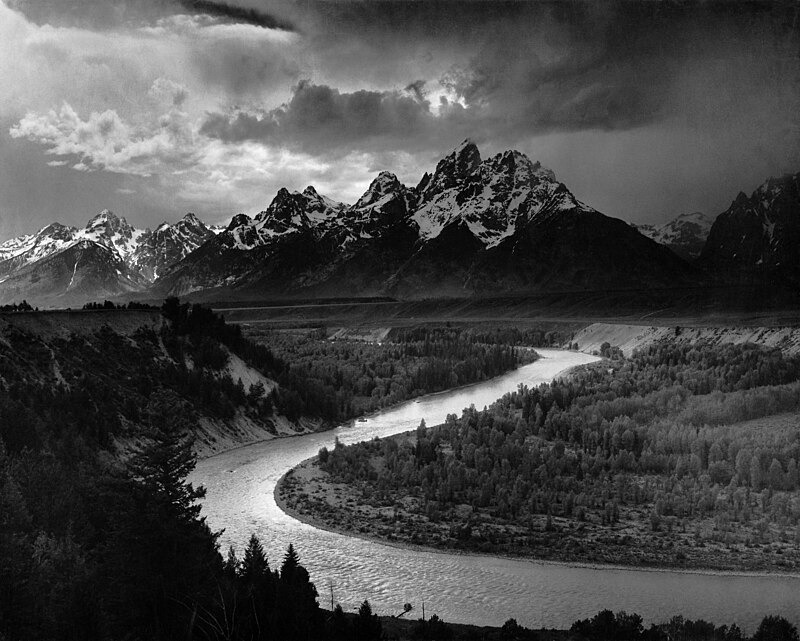
Adams The Tetons and the Snake River.jpg 

The Tetons and the Snake River (1942) Grand Teton National Park, Wyoming. 
Photograph by Ansel Adams. National Archives and Records Administration, Records of the National Park Service. (79-AAG-1)


This image has been living with us for 30+ years in various sizes, as a poster, a calendar, a postcard, currently as a framed print. On the wall in paradise, facing you just as you came inside from the lush green tropical day, in our kitchen above the table where we eat, on a bathroom mirror, in the hall where appointments are recorded on a blackboard, above the piano in the sitting room and now on the wall in my study.
I went through a serious Ansel Adams phase with many more reproductions gracing our walls but this is the one that endured. 
I rarely look at it these days. It's of course stunning as ever. 

We like to think that it stays here on the wall because of the Golden Record. And the Golden Record is out there aboard the Voyager spacecrafts since 1977, now travelling in interstellar space, 18 billion kilometers from earth. You can track both spacecrafts online. 
One day it may arrive somewhere and who knows, the record will be watched and listened to, laughed or shouted at, understood or misunderstood.  Carl Sagan and his team, who assembled the contents, included lots of (to us) beautiful stuff: the sounds of wind, volcanoes, waves, thunder, birds, frogs and wild dogs. They gathered 115 images, including a woman breastfeeding, an x-ray of a hand, photos of seashore, sand dunes, fallen leaves, a tree with daffodils, a flying insect with flowers. Music by Mozart and Bach, Chuck Berry and Peruvian pipers, Georgian chants and Indonesian gamelan, Beethoven and Louis Armstrong.
And this photograph by Ansel Adams. 

Nothing about genocide, wars, nuclear weapons, plastic inside dead whales, melting polar ice caps, noxious pesticides, bleached coral reefs, gun violence and suicide bombers.

In any case, folks, we are ready. When the first arrivals from outer space walk into our home, they'll recognise this picture and we'll be off the hook. Hopefully. And once we are done with the greetings, there will be a lot to explain.

Meanwhile, I am still struggling with a congested chest and packed sinuses without any proper sign of actual infection/inflammation but exhausted like an old dog and extremely grumpy, increasingly nervous about autoimmune relapse and shit. After breakfast, I shouted at R - only once, I swear - and his endless reassurances about how this will pass and like a stubborn toddler, I shall go to work tomorrow, no matter what. I have long lost any concept of what being fit and healthy should feel like.

23 April 2019

the right to be present, to attend, to be astonished

Halfway through the first episode of the BBC's The Earth from Space you can see how a vast cloud of red sand from a dead lake in the Sahara desert is slowly and gently carried by the winds all the long way across the Atlantic to the Amazon rainforest where the fine sand is rained onto the thick canopy delivering its nourishing minerals.

You ask yourself, surely this is not coincidental? You admit that it seems nothing short of a miracle and immediately, you can think of a string of such miracles (see the video below for example) which so obviously reflect how Planet Earth is looking after Planet Earth - without human input, our useless, destructive, cruel human input. Also, miracle, what a stupid word, how limiting, how human to describe what appears to be self evident, practical, sharing, caring. There, I said it, caring!

Early in 1982, I was with friends whose baby refused to be born on time and what should have been a short visit turned into two, almost three weeks of hanging around, playing cards, and going on shorter and shorter walks. I had a lot of time on my hands and - as you do - started a very amateurish translation of James Lovelock's book Gaia: A new look at life on earth. On a typewriter, while the mother-to-be was napping. 

The baby arrived when I was halfway through, it's a slim book. I finished the translation much later, pregnant myself, full of mother hunger, and sent it off to my father, a messy folder of typed pages. 
I suppose I wanted to impress him or maybe shock him. He was disappointed with me at the time as usual. I had dropped out of my university career. No longer the shining achiever at one of the oldest and most glorious universities, I was living in a small country that was falling off the edge of his world, baking bread.
He wasn't impressed at all. He told me, would not waste his time reading it.

Many years later, though, at one of these family events where we all stand around, glasses of something in our hands, fake smiles and faked interest, I heard him, he was standing a few steps in front of me, talking to his cousin (who had invented something of photovoltaic importance and thus had earned some respect from my father): yes, Lovelock, indeed, of course I read his first book many years ago. 

Now, another decade later, he calls me and we remember, as if it was yesterday, how he received this folder from me and how impressed he was reading it, still is, and yes, yes, Lovelock, amazing, just recently, someone mentioned him on tv.


19 April 2019


Within 48 hours we moved from winter coats and mittens to "too hot for lunch outside". I went to bed last night with the plan to write down the names of all plants in bloom in the garden - with pictures.

 I woke up at sunrise with the familiar throbbing in my ears that accompanies an attack of vertigo. After some cursing and punching of pillows I crawled below the open window and listened to the morning activities in the almond tree (mostly insects but also a somewhat lost woodpecker and courting pigeons).

Today being Good Friday means that it's very quiet. The church bells had their last fling yesterday evening and will stay silent until Easter morning. There will be no cinemas open today, no dancing or music for the few who will stumble mistakenly into a sorry pub tonight. Also, Sunday rules apply. Only bakeries are allowed to open for a few hours in the morning because: bread (one day I'll explain, there are currently five bakeries within walking distance in our suburb with a total of 55 different  varieties of bread alone on a normal day). If you run out of milk or toilet paper on a Sunday or Good Friday or Easter Monday your only hope is the next petrol station. And good luck to you.

You see, this secular country takes its church holidays very seriously. May is the busiest holiday month with Whitmonday, Corpus Christie and Ascension  (both always on a Thursday - excellent for bridging day planning thank you Jesus) and for good measure we also get the 1st of May off for no holy reasons but to celebrate trade unions.

As for today, R made waffles for lunch and we have a decent supply of milk and toilet paper. We will manage.

I am officially under doctor's orders to show up at the A&E with the next vertigo attack but we decided to stay under the radar for now.  It's a holiday after all. I'm afraid that's all my spinning head can type for now. Actually I am impressed myself but then I am a vertigo veteran.

16 April 2019

skidding in broadside

Our hands contain bones almost perfectly like-for-like with the bones in the flat paddle of a dolphin’s fin, and with a horse’s front legs, and a bat’s wings.

No. This is not about evolution because we - humans - did not evolve from dolphins or horses or bats. If anything, we all evolve out of the same mushy green swamp after the stardust had crashed and created the planet. Or something like that.

My hands, the odd fingers bent this way and that by polyarthritis, ache and on - what I still call - bad days, my wrists are stiff and hot. I search for images of dolphin's fins and try to be amazed.
And reassured. Many years ago, holding myself carefully still at the side of a traditional rig sailing ship (whatever possessed me to go aboard?), seasick as never before, I watched my six year old and her father out there in the Indian Ocean swim with dolphins while the evening sun was setting at the horizon.

Anyway, I am getting used to it. Also, we changed the handlebars of my bicycle and invested in a gel-padded cycling gloves. This is exciting news to someone like me whose mode of getting from A to B has always been cycling. In fact, these gloves are almost one step too far as I am certainly not a fitness colourful lycra with snazzy helmet cyclist.

My grandmother cycled all her life, to the baker, the butcher, to church, she cycled to deliver her apples and home made jams to friends and family in town. After she had turned 80, rumour was that the police stopped the traffic on market day when she cycled to buy potatoes and onions and carrots. I am that kind of cyclist. I don't wear a helmet.

All I need now is to recover from a trifling chest infection that has sneaked up on me. Which has me flat out and wobbly. And of course I am already fretting about my job and what if this is getting worse (we are on day 3!). I have a sick cert until Easter Monday, after which, if I haven't improved, I'll go back to my lovely GP and we'll take from there. I have no idea why I am in such a heap about it.

In the words of the great Hunter S Thompson:

Life should not be a journey to the grave with the intention of arriving safely in a pretty and well preserved body, but rather to skid in broadside in a cloud of smoke, thoroughly used up, totally worn out, and loudly proclaiming "Wow!What a Ride!"


11 April 2019

Last night after dinner we packed a small overnight bag, got in the car and drove for a couple of hours to one of those empty cities further north. A city with ancient history and which after  complete destruction during WWII was hastily rebuild as a faceless, featureless assemblage of buildings and streets and a couple of parks here and there.
We arrived at the worst hotel because I had left it too late to find a room anywhere else. It took me a while to locate the off switch for the empty minibar fridge - once I had figured out where the loud rumbling noise was coming from. That was at 3 am. R was snoring. I discovered that the towels were unwashed after I had a shower at daybreak, and so on.
Right on schedule at 8 am, I presented myself at the university clinics of this city to be seen by a renowned expert in witchcraft and vertigo - an appointment I had been waiting for since last September. She asked all the questions I wanted her to ask and answered all of mine, sent me through four hours of diagnostics and waiting and now we are starting plan B also known as me being guinea pig and let's see what happens if we go down this route. In short, keeping fingers crossed - albeit with drugs.
Back home, I wrote a scathing online review of the hotel because, seriously. (It's a first for me.) Then I read in the London Review of Books Colm Tóibín's memoir of his recent cancer treatment  and with my head swirling with fears of death and loss and feeling foolish and very small, I started to cry for a long while.
 
"It all started with my balls. I was in Southern California and my right ball was slightly sore. At the beginning I thought the pain might be caused by the heavy keys in the right hand pocket of my trousers banging against my testicle as I walked along the street. So I moved the keys into my jacket pocket. The pain stayed for a while and then it went away and then it came back. I was doing readings every day, selling my melancholy stories to the people of Orange County and places south. I wondered, some days, if there might be a doctor in the audience who, if I made a suitable announcement at the end of the reading, could make this pain in my right testicle go away. But I didn’t want to make a fuss."


05 April 2019

alive and kicking

Every cell inside of me should know by now that I cannot ask for more. That this is all there is, all the support, help, interest, all the research and therapy options, all the drugs, and all the sympathy I will every receive, ever deserve. I cannot ask for sacrifices, cannot ask for other people's lives be put on hold, that they diverted too much from their own lives' goals, their purpose, their desire, or their joy.
Nobody can cut a slice out of their healthy life and pass it on to me. That's not how it works. In the long run, I am here to handle it alone. And while it is often difficult, I am well aware how vital it is to show that I can cope, to put on a brave face.
To even make a joke about it, sprinkle some dry humour on this mess from time to time.

Cue another gem from my very distant classical education, this one from Seneca, the Roman philosopher from Cordoba. If I remember correctly, he was also a satirist.  You never know how to read a satirist.

The greatest obstacle to living is expectancy, which hangs upon tomorrow and loses today. You are arranging what lies in fate´s control and abandoning what lies in yours. What are you looking at? To what goal are you straining? 

I am writing this on a Friday night, listening to the playlist I made for my grandchild earlier today - or rather for my daughter to listen to while breastfeeding and bouncing her baby and remembering the days when I swung her around on my hip, when danced in the kitchen and jumped on the bed together.
Earlier, I sent the man out into the world for drinks and live music with the healthy world while I grandly stifled my urges to shout something mad and angry about unfairness. Something I would regret later.
But I repeat myself.


04 April 2019

Just a bit of background to my last post.
As far as I know it began on fb by a group of writers/translators in Germany on International Women's day. Someone started a discussion on why is it still blue for boys and pink for girls. I must admit that I got this second hand as I am not on fb.

The discussion spread on to a couple of blogs (where I read it first hand) and someone wrote a short text and then the next person used the format of this original text for their thoughts and so on.

I suppose that's called a meme.
Several blog posts all beginning with "My favourite colour is..." and ending with "I don't think I've ever done anything just because I'm a woman/man. I think we should finally stop the male women thing and talk about people." but with individual variations of what's written between the beginning and the end.

That's what I did. Just to see what happens.

Try it. You can use my text and change it to your specifications.

02 April 2019

My favourite colour is blue. I love cycling more than driving and I can read maps. I am shit at parallel parking. I usually wear jeans but in the summer, skirts and dresses because I feel comfortable in them. I can work with figures and can calculate expenses and such but was never good at maths in school. I definitely think logically. I have about as many male friends as female friends. I can operate a power drill and plenty of other tools, and sometimes I even enjoy it. I know how to mix cement and plaster a wall. I can bake bread and make yogurt. I have been with the same man for 30+ years. None of us would have ever come up with the idea that the housework would be my job. I can be envious or jealous and I sometimes compare myself to others. It usually is my job to take care of everything that has to do with money and forms, but not always with enthusiasm. I love ironing, seriously, I do. I am not ashamed of my educational gaps and my occasional political disinterest. I have one child and that has been the most enriching event of my life. I like nice clothes. I'm great at finding things super. I no longer like to flirt but I am good at empathy. I know how to sew on a button so that it looks good and stays on. I can knit really well but dismally fail at sewing.  I like to sleep in. I can bring structure to chaos. I like having visitors but I hate cooking for them. I unashamedly exploit the fact that I live with a cook and a gardener. I have been working with scientists for almost 20 years and nobody has noticed - to date - that I am actually shit at science. My husband is a scientist and he knows and I don't mind. I like to eat. I do not consider myself particularly beautiful. I like to swim in natural waters. I like hugs. I like humans and cats. 

I don't think I've ever done anything just because I'm a woman.

I think we should finally stop the male women thing and talk about people.

(as initially suggested by Ruth Löbner)


27 March 2019

a post in 5 quotes

Life is only worth living because we hope it will get better and we'll all get home safely.
 Deborah Levy

In psychology, the six basic emotion theory is very popular. It is is based on facial expression studies, and postulates that there are six emotions — anger and fear and so on — that we share with other species, and that we share them across the board. And that all of the other emotions [besides those six] must be uniquely human. So if you talk about, say, jealousy — that’s a human emotion, because it’s not on the list. Or love is not on the list. Even though we have quite a bit of evidence of the Oxytocin system [a bonding hormone] in other animals. There’s a lot of evidence that attachment and bonding occur in other species, of course.
But the more I think about it, I cannot name any emotion that is uniquely human. There are maybe emotions related to religion — let’s say spirituality — but even for that, I cannot exclude that animals have those kinds of feelings. Who says they don’t? In humans, religious feelings are not expressed in the face. That kind of emotion is not visible. And if emotions are not visible, how can we exclude that it exists in other species?
Frans de Waal

When a boundary in the known world— say, a geographical one . . . —becomes instead a beckoning horizon, the leading edge of a farther destination, then a world one has never known becomes an integral part of one’s new universe. 
 Barry Lopez 

If you want to build a ship, don't drum up people to collect wood and don't assign them tasks and work, but rather teach them to long for the endless immensity of the sea.

 Antoine de Saint-Exupéry

The nature of the sadness that is and will be experienced in the face of the effects of global warming . . . struck me as unlike anything in memory or imagination. It occupies an entirely new category. Though it may contain aspects of malaises we know quite well, like regret, nostalgia, penthos, depression and despair, there [is] an unnamed something else; it seems as a whole to be other than conditions we are familiar with, other even than these in novel arrangement, with an unidentified intensifier.
Tim Lilburn

25 March 2019

after Christchurch

National Anthem

I pledge allegiance 

to love and good coffee
a sleepy heart
two sets of feet burning
a clatter of brilliant voices raised as one
I pledge my honeycomb tongue

to the five stages of peace

Anger
Resilience
Open palms
History
and New Beginnings

to broken and plastered hope
to our phoenix youth
our devils dancing in the wind
sparkle and ashenning the day
the ancient maps left for us

to worship
or forsake
 
I pledge a bowl of molasses
and my grandmother’s laugh
to whoever will laugh with me
wrestle from the sun a hurricane
of Jinn stories and inside jokes
of multi-tongued monsters
finding homes in each other

I pledge myself to 

no flag
no border
no house of tress
no fairytale past
no charismatic king
no industry of false profits
burying their heads in the sand
                               
to them I only pledge
a steady voice
an untroubled heart
a desperate compassion
a fist raised in the air
                                
to those who would plot to sow me love
to bake me warmth and never break my art
to rob my eyes for safe-keeping
to drown me in unconditional trust

to build with me
a new sun

I pledge myself
to you 


21 March 2019

spring equinox


There is a short poem by one of the Romantic German poets that to my mind is all about this day. Spring equinox. The first day of spring.

(The Romantic era in Europe was at its peak during the first half of the 19th century. It was all about emotions and passion and expressing one's feelings, while remaining very male and suffering for it - think Goethe's The Sorrows of Young Werther.)


Anyway, the poem. It's by Eduard Mörike, who started out as a young suffering artist, all the heart ache of a poet and a musician with passion and feeling, briefly became a Lutheran pastor and eventually had a career as a respected professor of literature. I must admit, I don't know much else about him despite my attempts efforts at German literature. He is not well known these days anyway.
But this one poem, almost everybody knows some of it. Nine short lines. My parent's generation learnt it by heart, my generation did it for fun. I remember the day when my third grade teacher read it to the class on that first day of spring and how later, during recess, we were reciting it in dramatic or whimsical voices, giggling even. I also remember that it was a cold and rainy day, that the wheels of my bicycle had skidded on the mucky field track we used as a shortcut to school and that as a result, my shoes were filthy. I remember thinking, how can this mucky, wet day be the first day of spring. I was nine years old.

There are a couple of weird and wondrous translations online, I opt for this one by an anonymous source (the German original is here):

Spring's blue ribbon
flutters through the air again.
Sweet familiar scents
drift over the countryside, full of promise.

Violets are already dreaming
of their time to come.
Listen - the  soft sound of a distant harp.
It must be you, spring.
It is you I have heard.

Some years ago, on the first day of spring, a friend working at the local whole food co-op draped a silky blue ribbon over the front doors. Just a ribbon that fluttered ever so slightly when the doors opened. And every time someone stopped and mumbled or quoted or spoke or sang at least the first line of that poem, she discretely put a tick on a tally list. But only for the first hour. Because literally everybody who walked into the shop that day did that, some unconsciously, almost automatically, but mostly with a smile.

That's school for you. Powerful romantic stuff they teach you there.  And that poem, it's still on the curriculum, I checked.

19 March 2019

On the Strength of All Conviction and the Stamina of Love

Sometimes I think
we could have gone on.
All of us. Trying. Forever.

But they didn’t fill
the desert with pyramids.
They just built some. Some.

They’re not still out there,
building them now. Everyone,
everywhere, gets up, and goes home.

Yet we must not
diabolize time. Right?
We must not curse the passage of time.

 Jennifer Michael Hecht 

17 March 2019


Waleed Aly speaking

(Australian writer, academic, lawyer, media presenter and musician)

13 March 2019

patience was never my strong point


We are a feather falling from the wing of a bird.
I don't know why it is given to us to be so mortal and to feel so much.
It is a cruel trick, and glorious.

Louise Erdrich


Also, ageing, growing old, watching the body fraying at the edges.
The lingering pain in your left wrist joint you ignored for the last six months suddenly explodes and another chapter of the endless story begins. Call it Road to Ruin. Or better still: Not Fair.
No cycling. No cycling!
Not now, with the first magnolia and almond trees in bloom. You want to howl like a teenager.
You start walking and come home after two hours exhausted and with blisters on your feet. Triumphant. Foolish. Your wrist is by now a swollen throbbing red lump. You tie an ice pack around it and ignore it because you will not grow old, ever.
At least not in spring. Not this spring.
You watch a Belgian thriller with another ice pack dripping around your wrist and while the detectives run through thick summer forests shouting in French, you whisper to yourself, two weeks, maybe three, green canopy, flowers, asparagus, strawberries, butterflies, birdsong.

X-ray tomorrow.

09 March 2019


"All of us—all life on Earth, including humans—are going through this horrible event called global warming. The way we talk to each other about it is also pretty horrible. We yell facts thinking that this will inspire and persuade people. We need an ecological language that doesn’t make the person who served me at my local fast food place feel stupid or evil.

Guilt is about individuals. Global warming is a billions-of-people scale problem. Let’s have a conversation about being responsible instead. If you can understand something, then you’re responsible for it."

Timothy Morton 

"Never doubt that a small group of thoughtful, committed people can change the world; indeed, it's the only thing that ever has."

Margaret Mead
 

07 March 2019

addendum


The 300 year old plane trees in summer. Planted to orders from Karl Wilhelm Friedrich, Margrave of Brandenburg-Ansbach in the 17th century. The Wild Margrave, as he was called, had serious delusions of grandeur and spent money like there was no tomorrow. He was married to Friederike Louise, a daughter of the king of Prussia, the poor unfortunate woman was 15 years old at the time of this arranged marriage to secure Prussia's foothold in Franconia. The marriage was a disaster as could be expected. Here is the unhappy couple.

Friederike suffered from one of the congenital chronic illnesses of the European gentry and after the birth of the heir, she was exiled to a small castle not too far away, where according to my father, she spent her days among women "knitting and sewing".


I walked around the castle grounds, the buildings are currently being renovated to become a "tourist gem", and tried to imagine what life may have been like for a young woman, an outcast, in this godforsaken village, surrounded by carp ponds and fields, far away from any family or social life. Her firstborn died, she gave birth to two more boys, the Margrave arriving drunk and jolly in the middle of the night now and then, let's call it rape, and in her later life, she apparently suffered from melancholia.

The Margrave lead a life of luxury, with hunting and falconry and plane trees imported from France. He had palaces built all over Franconia and churches here and there to absolve for any sins.

Alexander, his heir, the second son of Friederike Louise, continued in this vein, with many mistresses and endless luxury. But no children. In the end, he sold the title to the Prussian king and abdicated, leaving his luxurious residences (incl. all staff and animals) without a second thought and no provisions. He then married his current, English, mistress, Lady Craven, moved to her manor house in Berkshire and spent the rest of his life there breeding horses - as one does.
Any similarities to current political leaders - anywhere?


Plane trees: http://bilddatenbank.natur.de/default.asp?BildID=4138
Photographer: Erich Kraus, Weidenbach, Germany

The couple, Unterschwaningen castle, Benham Park: Wikipedia, public domain


05 March 2019

Everything is all over the place. It seems I am waiting for I don't know what to happen. I wake up early and feel the tension building inside of me, will I get through the day, I wonder.
And of course I do. It's not bad, this life. Just maybe too much.

On Saturday, we walked along a magnificent tree lined avenue, I counted 60 plane trees. The original planting included 100 according to the written submission which was presented by one of my ancestors, a forester, to the Margrave of Ansbach in the late 17th century. Later, we unsuccessfully searched for someone to unlock the small chapel in the nearby village because I wanted to show off to R the commemorative plaque inside recording the planting and my ancestor's name. (It's only a tiny chapel.)
There was some rain and a fierce wind but 60 plane trees, leafless as they may be, can make a person very happy.


Shortly after that, I witnessed for the first time my father's onset of slight senile dementia as we got lost on the back roads for a few hours. He grew up here and usually knows this area like the back of his hand. He is 90 years old, I don't think he is aware of anything missing.

Today, I listened to a friend describing the effect of last summer's drought on forests and bird life. A drought that is ongoing and if we are heading into another hot and dry summer, he told me, we will see massive and irreversible forest die back. He is a botanist. He encouraged me to use a new German word: flugschämen (feeling embarrassed on account of flying when not absolutely necessary). We agreed that there should also be a word for feeling embarrassed on account of leaving the fight against climate change to school kids. Which resulted in agreeing to meet up on March 15th. Because there is no excuse. Where will you be?
Maybe you don't have to go far:  https://www.fridaysforfuture.org/events/map